B.C. Fire Departments Cohort

In the Fall of 2025, the B.C. Fire Departments Cohort launched to help fire departments in small communities strengthen their facilities for future fire seasons.
The Cohort connected fire chiefs from across the province with practical, expert-informed pathways to make their emergency response infrastructure more resilient and energy-efficient.
13 fire departments joined the cohort and received one-on-one consultation, recommended options tailored to their projects, and group webinars from industry experts.
The program brought together departments exploring options for upgraded water supply, sprinkler systems, and design options for new buildings. Participants learned from one another and from industry experts about practical ways to implement these solutions.
The Cohort was delivered by CRIS and the Fire Chiefs' Association of B.C.

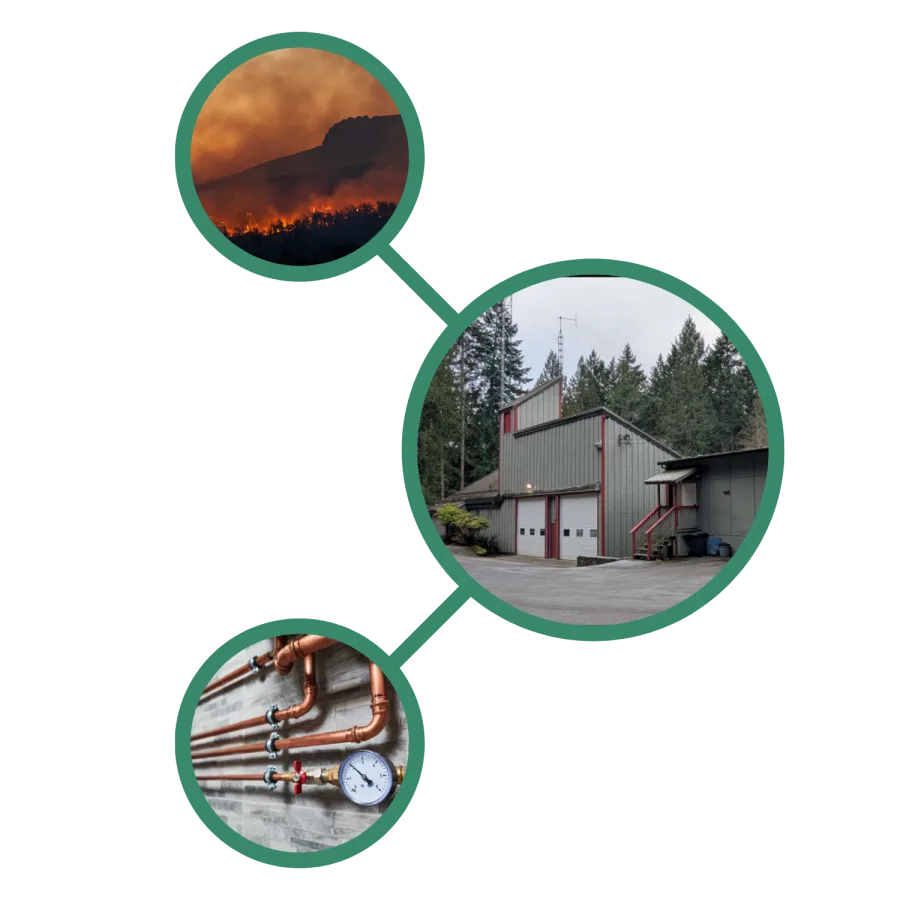
Cohort At a Glance




Projects Advanced through the Cohort
Challenges
Fire Departments in B.C. joined the Cohort to explore solutions to a range of climate-related challenges, including:
- Issues accessing a safe and reliable water supply
- Sprinkler systems that can protect buildings from wildfires
- Increasing demand for reception areas that protect communities from wildfires and wildfire smoke
- Upgrades to back-up battery power sources to reduce energy use and operating costs
- Resilient design options for new or retrofitted fire halls that are safe for workers and adapted to future climate risks
Support Provided
Participants received one-on-one expert support and technical options reports tailored to their projects, including:
- Energy use assessments and audits to identify energy cost saving measures
- Climate Hazard Analyses to identify current and future risks to fire departments and emergency response infrastructure
- Cost-benefit analysis to help prioritize upgrades
- Technical design options for new fire halls or retrofit projects
- Guidance on funding opportunities for fire departments and peer discussions on funding pathways



Webinars and Peer Learning Topics
Presented by CRIS Roster expert WSP, this session supported departments in developing strong, fundable proposals for infrastructure upgrades. Topics included a summary of potential technical documentation for grant readiness, a summary of different grant streams available, and consideration for scalable solutions for small departments.
Presented by CRIS Roster Expert RDH Building Science, this webinar explored the Wildland Urban Interface, highlighted the risks wildfires pose to communities, and outlined effective strategies for preventing wildfire spread to buildings. Attendees learned the key principles of wildfire-resilient construction, typical vulnerabilities in building enclosures, and recommended materials and assemblies for roofs, walls, soffits, windows, doors, gutters, vents, solar panels, and elevated structures. The session shared actionable recommendations and community-level solutions for enhancing wildfire resilience.
Presented by CRIS Roster Expert Four Winds, this session provided professional guidance on achieving energy efficiency and emissions reduction through facility retrofits. This educated fire departments on the core principles of improving the building envelope (insulation, roofing) and modernizing mechanical systems, and how to prioritize upgrades for the greatest impact on operational costs and GHG reduction pathways.
This practical session on reducing operating costs and emissions through energy awareness, efficiency strategies, and internal collaboration was presented by CRIS Roster Expert Kerly Acosta Hitchcock.
Participants learned to:
- Define energy management and greenhouse gas emissions.
- Identify low-cost and high-impact energy saving strategies.
- Explore collaborative approaches across departments
CRIS Roster Expert Focal Engineering presented on building resilience against wildfires and other climate risks.
The presentation walked through fire hall design options for resilience to climate change, such as wildfire events and smoke scenarios (e.g. ventilation and envelope), and future climate scenarios (e.g. overheating as temperatures increase).
This webinar, presented by cRIS Roster Expert Pratus group, provided a practical overview of solar photovoltaic systems and building-integrated panels for fire halls, covering battery backup for resilience, essential design and installation considerations, integration with existing systems, and real-world performance examples.
The session provided
- Overview of solar PV systems and building-integrated technologies
- Battery backup systems and their role in resilience and emergency operations
- Key design and installation considerations for fire halls
- Integration with existing building systems and future-ready design
- Case examples and performance data
"[The Cohort has] given me a better understanding of how to apply climate resiliency and carbon reduction in practical ways as well as informing our proposed fire station renovation and expansion project."
Now Open to Fire Departments Across Canada
After successfully supporting fire departments through the B.C. cohort, we're partnering with the Canadian Association of Fire Chiefs (CAFC) to bring this program to fire departments across Canada. The next Fire Department Cohort is open to CAFC member fire departments serving populations of approximately 30,000 or less that have a planned or ongoing infrastructure project. Launching in fall of 2026, the program provides free expert guidance to help fire departments strengthen climate resilience, improve energy performance, and support reliable operations during emergencies.
Applications are now open and will be accepted until October 23, 2026. Eligible CAFC members can register below.